
Zaawansowana optymalizacja w służbie niezawodnego i efektywnego transportu publicznego
The goal of the project is to develop optimization algorithms (and methods for their potential implementation) aimed at improving the quality of public transportation. Ultimately, the methods developed as part of the project will enable the planning of reliable and optimal public transportation through the use of modern technologies, and in particular, will help achieve and maintain a high level of passenger satisfaction despite the occurrence and spread of disruptions. The project will result in: demonstration algorithms (so-called “proof of concept”), software capable of addressing disruptions in public transportation, and scientific publications on the aforementioned topics.
Public Consultation
On Monday, January 26, 2026, at 4:30 p.m., the third online consultation with the passenger community took place. The purpose of the meeting was to discuss issues related to disruptions in public transportation services in the Silesian Voivodeship, with a particular focus on rail transportation, as well as to promote modern methods for solving transportation problems, including quantum methods. In addition, the consultation aimed to foster a positive public perception of public transportation and within the scientific community by presenting the research findings and practical applications of the ongoing project.
During the consultation, it was pointed out that quantum computers can be used to solve small-scale scheduling problems based on real-world data and network structures. The current state of quantum technology does not yet outperform classical methods for larger problems (more extensive networks, a greater number of trains), and the computations themselves remain costly. Nevertheless, the use of quantum solutions sets the direction for the development of this technology and highlights its potential applications in public transportation, including rail. As a first step, the importance of a hybrid approach is emphasized, in which a small but particularly complex (or susceptible to stochastic disturbances) part of the problem is solved on a quantum device, while the remainder is solved on a classical computer.
Software
Demo software for solving public transportation problems, designed to be accessible to a broad audience https://github.com/iitis/demonstrator-kolejowa-optymalizacja
Promotion of the project in cooperation with foreign partners
https://umbc.edu/stories/quantum-on-track-for-train-scheduling/
https://www.youtube.com/watch?v=xWKRhIeoCoA
https://www.nature.com/articles/s41598-025-15545-0/metrics
International Cooperation
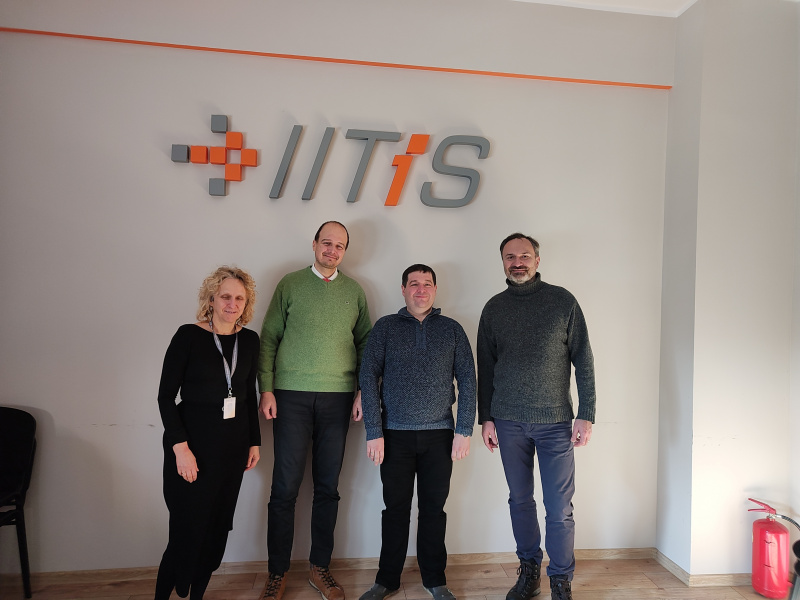
On January 19, 2026, IITiS PAN hosted a visit from Prof. Peter Márton, Vice Dean for International Cooperation at the Faculty of Management and Information Technology (FRI) at the University of Žilina (UNIZA), who specializes in applied mathematics, operations research, logistics, transportation, and data analysis, and who is actively publishing and collaborating in the fields of technical sciences and computer science.

______________________________________________________________________________________________________________________________
Project co-financed from the state budget, allocated by the Minister of Education and Science under the “Nauka dla Społeczeństwa II” Program
Agreement number: NdS-II/SP/0336/2024/01
Grant amount: 1,000,000 PLN
Total value: 1,000,000 PLN
Date of agreement signing: April 2024



Machine-translated
Przetłumaczone maszynowo